S1E2 The Soccer Pitch Explained: Dimensions, Lines, and Key Areas


A beginner-friendly guide to the layout of soccer fields and the terms commentators use to talk about them


Introduction
The soccer field, officially called a pitch, contains a lot of structure that helps organize and direct game play. In the first regular episode of our new soccer podcast, we help casual viewers and people curious about soccer understand the layout of the markings, areas, and equipment on the pitch to make watching soccer much easier and more enjoyable. This guide summarizes the points we talked about in the episode to explain the dimensions of a soccer pitch and its most important lines, boxes, and other features.
The Shape and Size of a Soccer Pitch
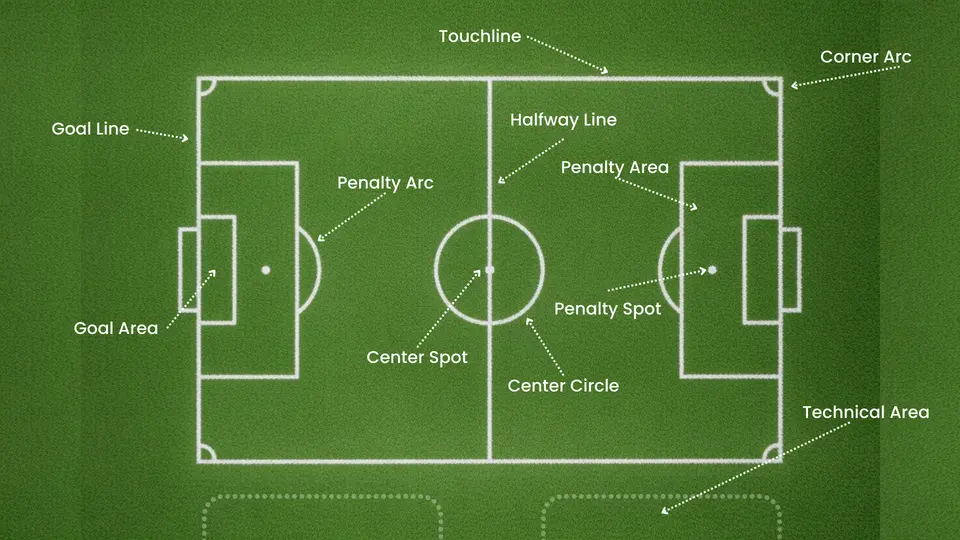
A soccer pitch is rectangular, but its exact size can vary widely depending on the league or competition. For international matches and Major League Soccer (the top soccer league in the US), the field has to be between 110 and 120 yards long and 70 to 80 yards wide. That makes it roughly the same length as an American football field including the end zones. But soccer pitches are noticeably wider; football fields are only about 53 yards across. A commonly recommended soccer pitch standard is 115 yards long and 74 yards wide (for a run of jokes about how soccer pitches change size, see this clip from Ted Lasso).
Boundary Lines and the Halfway Line
The long sides of the pitch are called touchlines, while the short ends are known as goal lines (often informally called end lines). Dividing the pitch into two equal halves is the halfway line. You may also hear it referred to as the midline or center line. Americans sometimes mistakenly call it the midfield line, or even the 50, like the equivalent line on a football field. Don’t do that!
The Center Circle and Kickoff Spot
In the middle of the pitch is the center circle, which has a diameter of 20 yards. At the exact center of that circle is the center spot (officially called the center mark, but you won’t hear that as often). The center spot is where kickoffs happen.
Goals and the Goal Frame
At each end of the pitch sits the goal. It’s 8 feet high and 24 feet wide. The vertical sides of the frame are called posts, and the horizontal bar connecting them is the crossbar. The posts and crossbar sit directly on the goal line, so if a shot misses the frame, the ball is almost always out of bounds. Together, the posts and crossbar are sometimes referred to as the “woodwork,” a relic from the time when goals were actually made of wood (now they’re metal). You will often hear commentators talk about “front” and “back” posts. These are relative terms referring to their distance from the player in possession of the ball. The post nearer to the ball is the “front” post, and the far post is “back.”
The Penalty Area and the Goal Area
In front of each goal is a large rectangle called the penalty area. There are many alternative names for this area: the 18‑yard box, the penalty box, or simply “the area” or “the box.” It extends 18 yards from the goal line and spans 44 yards across. Inside it is a smaller rectangle called the goal area, or six‑yard box, which is 6 yards deep and 20 yards wide.
The Penalty Spot and the ‘D’
Twelve yards from the goal line and centered between the posts is the penalty spot, often simply called “the spot.” Like the center spot, its technical name is the penalty mark, but you won’t hear that very often. This is where penalty kicks are taken after certain fouls. Just outside the penalty area is a curved marking called the penalty arc, often nicknamed the “D.” Its purpose is to ensure that players remain at least ten yards away from the spot when a penalty kick is taken, similar to the function of the free throw lines in basketball.
Corner Flags and Corner Arcs
Each corner of the pitch has a flag and a small arc drawn one yard from the flag, connecting the touchline and goal line to form a quarter circle. This arc marks the area where the ball must be placed for a corner kick.
The Technical Area
Outside the field of play are two technical areas. These contain the benches where coaches, substitute players, and staff sit during the match. The area must be positioned at least one yard away from the touchline, but it’s typically much farther back.
Why Learning the Pitch Matters
Once you understand the layout of a soccer pitch, commentary and game strategy become much easier to follow. For new fans, learning pitch structure will make you feel more confident watching the beautiful game. Our upcoming episodes will build on this knowledge to explain positions, game play, fouls, and much more!
Follow Soccer Explained!
Follow the show to hear two American fans who work for a soccer team explain the essentials of soccer in short, digestible episodes. We also tell stories and share our passion for the game so you can join the excitement around America’s fastest-growing sport.
Credits and Contact
- Cohosts: Treencee Russell and Sy Hoekstra
- Production and editing: Sy Hoekstra
- Podcast Logo and pitch diagram: Riley Quarders
- Theme music: Andre Louis
- Get in contact: soccerexplainedpod@gmail.com
- Soccer Explained website created using Podpage.


